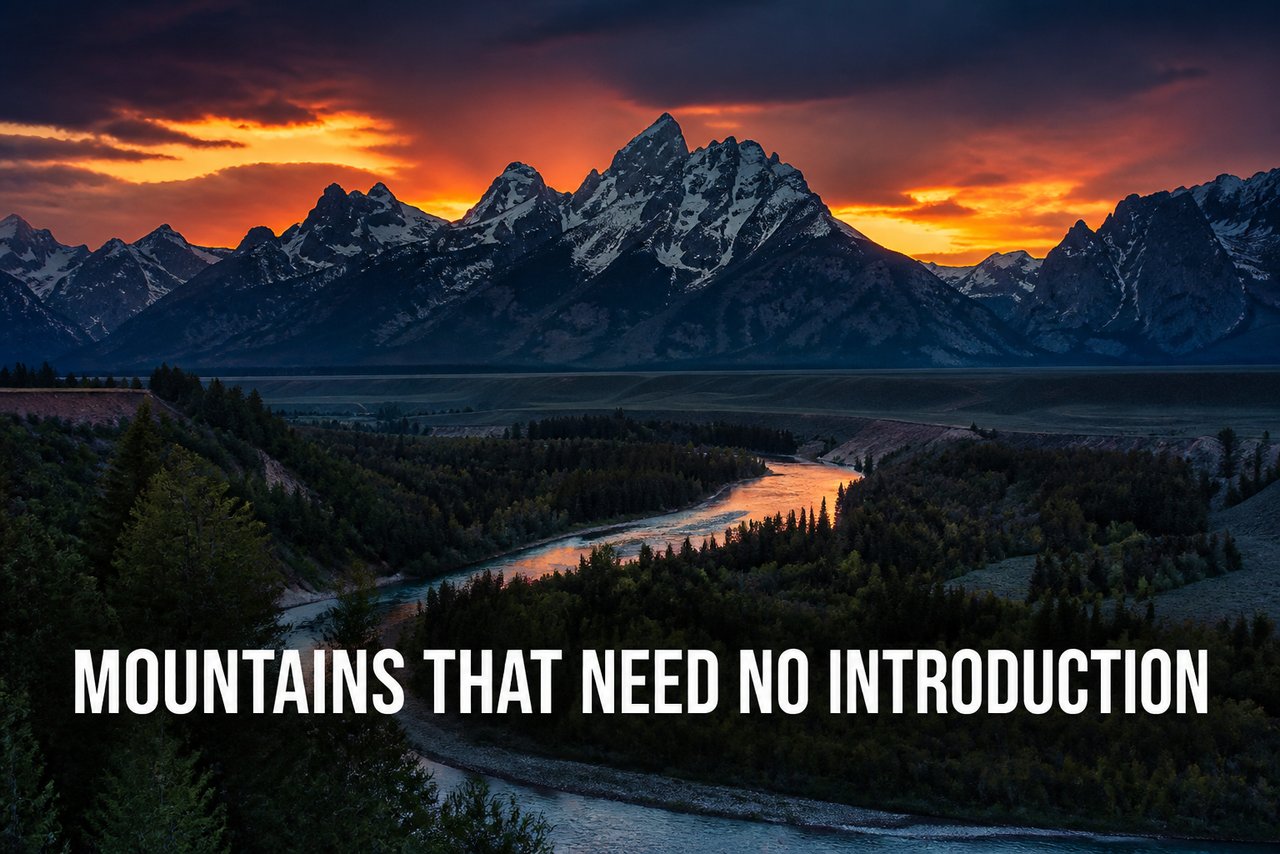
The Tetons: Mountains That Need No Introduction
Some mountains you earn by hiking to. The Tetons simply arrive - a twelve-thousand-foot wall of bare granite rising straight out of the valley floor, no foothills, no apology. Coming north out of the sagebrush on a clear morning, you will pull over at the first turnout, along with everybody else, because no photograph prepares you for how abrupt it is. The Tetons are mountains that need no introduction, so we will not give them one. We will just tell you how we like to see them.
The Story of the Range
The Teton Range is one of the youngest and steepest in the Rockies - a fault-block range still rising, its west side dropped and its east face lifted in great unbroken slabs. Without foothills to soften the rise, the peaks shoot from valley floor to summit in a few horizontal miles. Glaciers carved the big U-shaped canyons - Cascade, Death, Taggart - and left the lakes at their feet: Jenny, Leigh, Bradley, Taggart. The Snake River exits Jackson Lake and bends north, then cuts back south through the valley in that famous flat curve you have seen in a hundred photographs from the Snake River Overlook - the shot Ansel Adams made canonical.
The valley itself, Jackson Hole, kept its fur-trade name, and the human history is every bit as textured as the geology: the Shoshone who summered here, the mountain men whose rendezvous made the valley famous in the 1820s and '30s, the homesteaders whose barns on Mormon Row still frame the peaks in the best photographs in America. The park grew in pieces through the twentieth century - the original 1929 park protected the peaks, and John D. Rockefeller, Jr.'s quietly purchased valley lands became the Jackson Hole National Monument in 1943 before the two were finally joined. It is one of the great conservation stories of the West.
Our Day in the Park
Base-camped at Turpin Meadow, we did the east side properly: the loop road with stops at Oxbow Bend (do this at dawn; the moose and the mirror-flat water are why), Schwabacher Landing, Snake River Overlook, and Mormon Row with the Moulton barns. Jenny Lake got its own morning - the boat shuttle across, the walk up to Hidden Falls, and Inspiration Point for the view back down the whole glacial trough. Antelope Flats at dusk is the quieter pleasure: bison in the last light, the barns in silhouette, and the Tetons going purple behind everything.
For RVers the park is easy - the roads are fast by national-park standards, and the scenic pullouts do the work. Trailer-friendly campgrounds inside the park book out far ahead; the forest campgrounds east of the park are the value play. And between the park and the town of Jackson, budget an afternoon for the square, the elk antler arches, and the best bakery per capita in Wyoming.
Why the Tetons Stay With You
Some ranges are geography. The Tetons are a skyline - one of those rare silhouettes, like the Golden Gate or the St. Louis Arch, that a person can recognize from anywhere. Camp a few nights in their valley, walk their lakes, and watch the alpenglow go from pink to gold to gone, and you will understand why everyone from the fur traders to the photographers to two RV travelers from the 2026 season keeps coming back to the same turnouts to look at the same mountains.