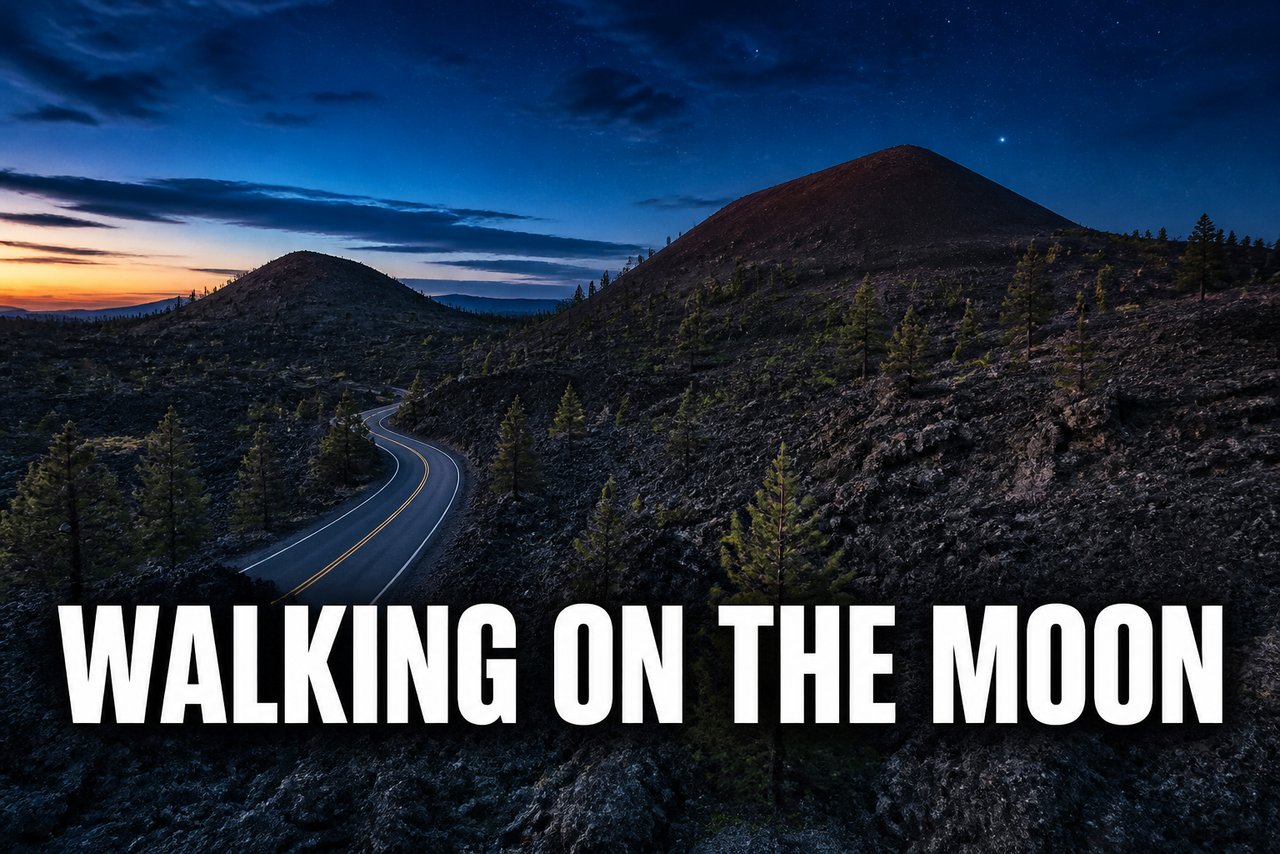
Craters of the Moon: Walking on the Moon in Idaho
Between the Lost River Valley and the Snake River Plain, the land turns black. Not figuratively - literally black, a sixty-mile-wide blanket of frozen lava with cinder cones rising out of it like islands, pine trees prying the rock apart, and a national monument road winding straight into the middle of it. Craters of the Moon is one of the strangest, quietest, most underrated parks in the system, and astronauts have used it to practice walking on the Moon. We just walked on it for a day and called it a highlight of the year.
An Ocean of Rock
The monument protects a remarkable volcanic field along the Great Rift, a crack in the Earth's crust where lava has erupted again and again over the past fifteen thousand years - the most recent flows here are young enough that geologists count their age in centuries. The result is a landscape of five different kinds of lava: smooth pahoehoe, clinkery aa, cinder fields, lava lakes, and block flows, all layered in a black mosaic that stretches to the horizon. From Inferno Cone - a short, steep scramble and the best viewpoint in the park - you can see the whole volcanic story laid out: cone after cone marking the rift, the Pioneer Mountains floating white on the horizon, and the Snake River Plain rippling away beyond.
Caves, Craters, and the Seven-Mile Loop
The park's paved loop road hops from one otherworldly stop to the next. Walk through the fragmented catastrophe of the Devil's Orchard, climb Inferno Cone, and bring a flashlight for the caves - lava tubes you can self-guidedly explore, from walk-in caverns to crawl-spaces the rangers rate by the amount of crouching required. The Broken Top and Tree Molds trails cross flow terrain where tree trunks left standing in the lava left perfect cylindrical molds in the rock. Wildflowers own the place in spring: paintbrush and dwarf buckwheat blooming out of bare cinder in colors you would swear were photoshopped.
Astronaut lore hangs over it all. Apollo crews trained here in the late 1960s, learning to read volcanic terrain before they went to the real thing - a nice reminder that this landscape really is otherworldly, not just in brochures.
RV Practicalities
The campground sits inside the monument among the lava outcrops - gorgeous, small, and mostly tent-and-small-rig sized, so larger rigs generally day-trip in from Mackay or the towns along the Snake River Plain, which is exactly what we did from Moose Crossing: an easy drive up 93, the loop road, a cave or two, a cone climb, and home for dinner. Bring water, sun protection, and closed shoes - the lava does not negotiate with sandals - and note that winter closes the loop road to cars but opens it to skiers, a trip we keep saying we should take.
If your 2026 travels take you anywhere near central Idaho, put half a day aside for the Craters. There is nowhere else like it in the system, and it pairs perfectly with the mountains you have just come down from: fire and ice, valley and volcano, all in one long weekend.