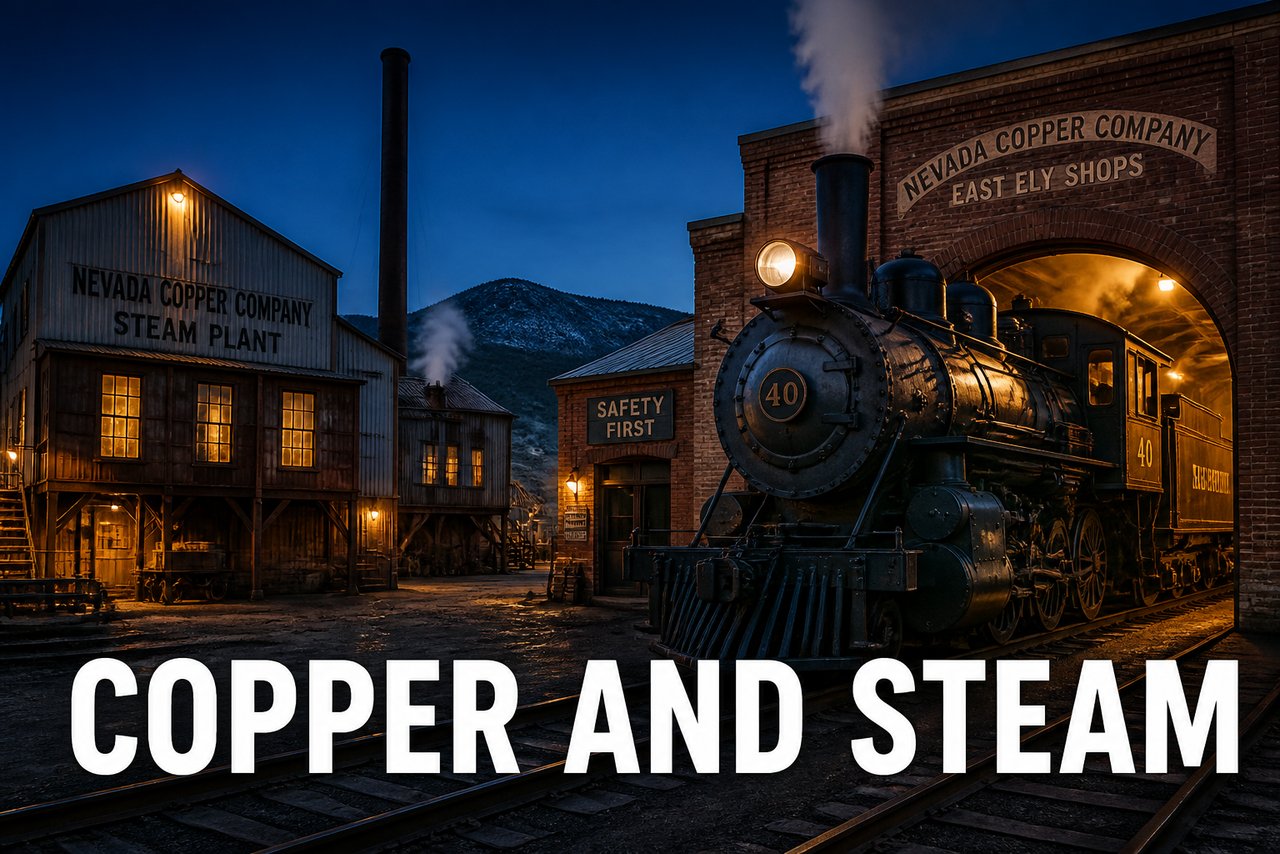
Ely: Copper, Steam, and the Hotel Nevada
Ely, Nevada, is what happens when a stagecoach stop gets lucky. Founded as a station on the territory's early mail routes and named in 1878, it sat on the map for nearly thirty years as a modest crossroads - until the mountains around it turned out to hold one of the richest copper deposits in the West, and the twentieth century arrived all at once, by railroad.
We rolled in off Highway 50 after the long haul across the passes, and Ely immediately felt like a base camp worth settling into: 6,437 feet of elevation, four real seasons, a historic downtown still wearing its boom-era face, and - the part that hooked us before we even parked - an honest-to-goodness working steam railroad running right through town.
Copper, and the Railroad That Hauled It
The copper boom arrived in 1906, and with it one of the most audacious projects in Nevada history: the Nevada Northern Railway, established in 1905 to link this remote mountain town to the outside world. Track reached the Robinson copper district in 1907-08, and for the next seventy-plus years the railroad did the unglamorous, indispensable work of hauling ore out and everything else in. The mines and the railroad rose together, boomed together, and - this is the rare part - ended together in 1983, when the copper mines closed and the last trains stopped running.
And then something remarkable happened. Instead of sending the locomotives to the scrapyard, the railroad's owners gifted the entire operation - engines, buildings, shops, rolling stock, the works - to a preservation group. What is now the Nevada Northern Railway National Historic Landmark is one of the most complete, original railroad campuses anywhere in America: some seventy historic buildings spread over a 56-acre yard, thirty miles of track, and century-old steam and diesel locomotives that still earn their keep.
The Best Railroad Experience in the West
We have seen our share of tourist railroads, and the Nevada Northern is in a class of its own for one reason: nothing here is pretending. The East Ely shops complex - brick machine bays, the roundhouse, the locomotive works - is the real thing, preserved the way the crews left it. You can walk the yard, tour the shops, and ride excursion trains pulled by steam or vintage diesel, depending on the season and the schedule. In summer, the steam runs; the hiss and the coal smoke and the whistle bouncing off the mountainsides make the ride a full-body experience.
For the full immersion, the railroad rents its caboose for the night - a stay with honest warnings: no electricity, no heat, and the bathroom across the tracks in the old crew bunkhouse. We have talked ourselves in and out of that booking twice now, which means it is happening eventually. The crews and volunteers who keep the place alive are great storytellers; do not leave without asking how the locomotives were kept running in the last years of the mines.
The Hotel Nevada and Downtown
Downtown, the six-story Hotel Nevada has presided over the town since 1929, and for decades it was the tallest building in all of Nevada - a claim to fame that tells you exactly how remote this corner of the state was. The hotel is still open, still wonderfully creaky, and its lobby and bar are a museum of a century of mining and gambling and celebrity traffic. Down the block, the six-churches-and-a-opera-house streetscape, the murals, and the White Pine Public Museum make an easy afternoon of walking.
The White Pine Museum is where you will meet the town's older history - mining camp artifacts, area fossils, and the story of the Shoshone people who called these valleys home long before copper put Ely on the map. It is a small museum with a big collection, and like everything in Ely, unhurried.
Base Camp for the Great Basin
The other reason Ely matters to travelers: it is the gateway town for Great Basin National Park, an easy drive east over Sacramento Pass. Fuel, groceries, an RV park, a brewery, and a diner breakfast that belongs in a movie - Ely is the full-service base camp for a park that famously has none of those things. The rhythm works: park days, then town nights, with the railroad yard lights glowing on the edge of town and the Schell Creek Range holding down the horizon.
We came for the national park and left talking about the railroad. That is the thing about Ely - it keeps outgrowing the reason you came. Give it a night, give it two, and take the train ride. The copper is long gone from the mountain, but the town that copper built is still running on its own steam.