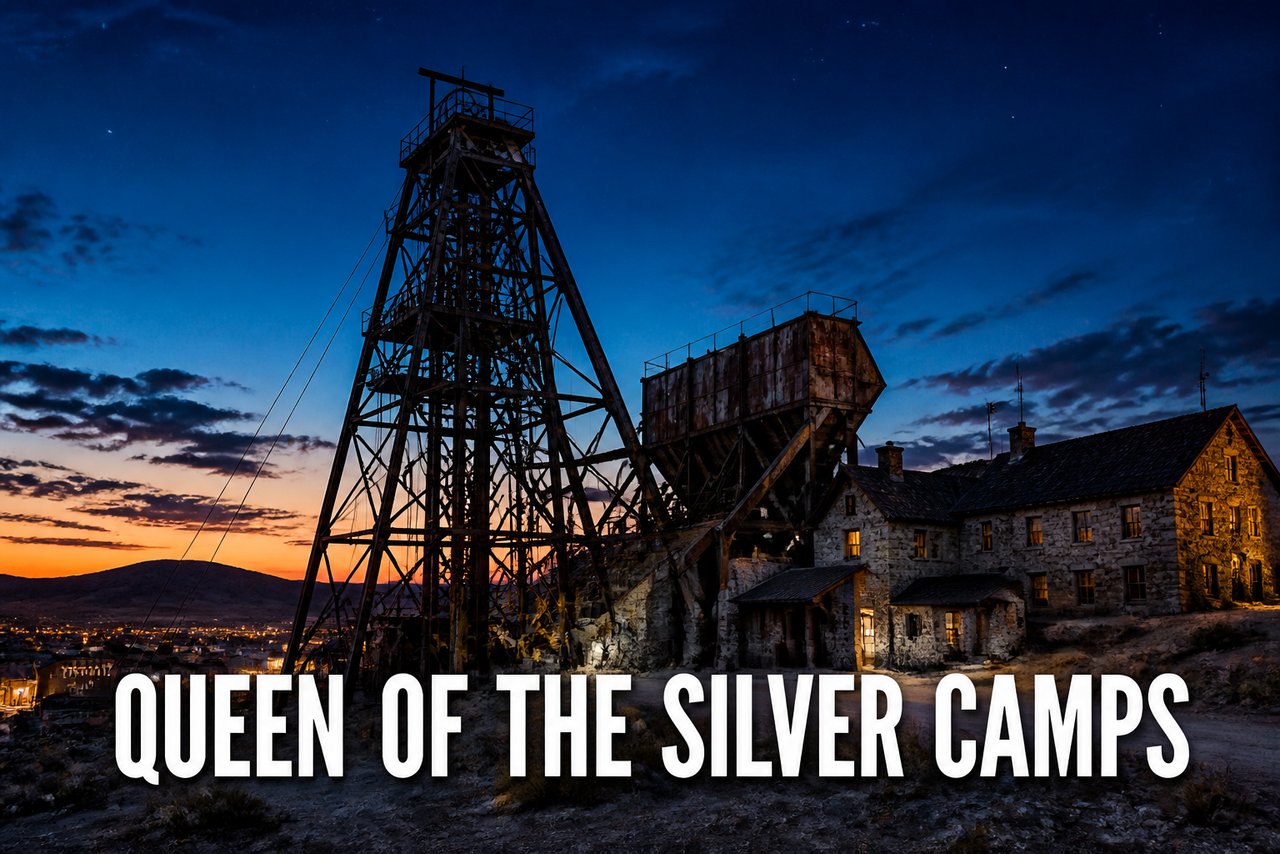
Tonopah Historic Mining Park: Walking Through the Queen of the Silver Camps
From discovery to mining company
The story begins with Jim Butler's 1900 discovery. The park sits on part of the original claims associated with Jim and Belle Butler, whose find helped bring Tonopah into national prominence. A popular account says that Butler, camped near Tonopah Springs, picked up a promising rock while trying to throw something at a wandering donkey. The sample proved valuable, and the discovery set off a rush.
The early history was shaped by leases, agreements, and changing ownership. According to the park brochure, Butler accepted the first lease on the claims in late 1900 and later sold the claims to the newly formed Tonopah Mining Company of Nevada. The company developed the property beginning in 1902 and worked the claims for years. When the price of silver fell, the mines were shut down, reopened under a leasing system, and eventually closed for good.
The ground later passed through additional ownership, including Howard Hughes's Hughes Tool Company. In the 1990s, the patented claims were leased and then transferred to the town of Tonopah, allowing the old mining ground to become the public historic park visitors can explore today.
The park's own history describes four major companies represented within its boundaries: the Tonopah Mining Company of Nevada, the Montana-Tonopah Mining Company, the Tonopah-Belmont Development Company, and the Tonopah North Star Tunnel and Development Company. That mixture is one reason the park feels more like an outdoor industrial district than a conventional museum.
Begin at the Visitor Center
The Visitor Center is the natural starting point. It contains a gift shop, indoor museum displays, mining artifacts, a mineral exhibit, restrooms, and a theater presentation about Tonopah and its mines. The building itself is part of the story. It was originally built in 1903, enlarged in 1905, and used by the Tonopah Mining Company as a power substation and telephone exchange. In the 1970s, it was remodeled as an assay office by Summa Corporation, the Howard Hughes company that owned the property at the time.
That is a useful introduction to the park's larger theme: buildings change use, companies change names, and the machinery may fall silent, but the physical landscape continues to connect the present to the mining era.
The Silver Top complex
One of the park's signature sights is the Silver Top complex. The brochure identifies the headframe and hoist house as 1906 structures, while the ore house, known as "the Grizzly," dates to 1907. The Silver Top is especially important because so much of its original arrangement survives: the headframe, hoist house, ore house, and the track bed of the Tonopah and Goldfield Railroad's Silver Top spur.
The Grizzly was part of the ore-handling process. Miners hand-trammed ore cars across an elevated trestle and dumped the ore against grizzly screens. Oversized material was separated out, while the smaller ore moved down to sorting tables. Miners hand-sorted the material, sent waste away, and directed the valuable ore into bins below. The brochure says the bin could hold approximately 450 tons of material - a reminder of the enormous amount of rock that had to be moved and processed to recover the valuable fraction.
The headframe is also a restoration story. In 2019, major work was completed to stabilize the structure, which had been in danger of collapse. The park's preservation work is ongoing, and the Silver Top complex shows why. These structures were built for industrial use, not as monuments. Preserving them means repairing foundations, replacing damaged timbers where necessary, and carefully balancing safety with historical accuracy.
Above the stope and below the ground
At Stop 4, a modern stope bridge allows visitors to walk directly over the original 500-foot underground excavation from which ore was removed. It is an unusual experience: the ground beneath your feet is not simply earth, but the empty space created by decades of mining.
Nearby, the Burro Tunnel offers an even more direct encounter with the underground workings. The brochure identifies it as one of Jim Butler's original discovery sites and the only tunnel on the property. Technically, the passage is an adit - a horizontal opening driven from the surface into a mine. At the end, visitors can step onto a steel viewing cage suspended over a 500-foot stope. The terms matter because they reveal how mines were engineered: shafts are vertical, adits enter horizontally, and underground passages could serve ventilation, drainage, haulage, or access.
The Burro Tunnel turns mining vocabulary into a physical experience. Instead of simply reading about depth and excavation, you can stand at the edge of the space the miners created.
The Mizpah mine
The Mizpah Mine was, according to the brochure, the richest of Tonopah's many mines. Its metal headframe was one of the first steel hoisting works built in the county. Restoration of the collar was completed in 2015, and visitors can stand on a grate over the lighted shaft and look down toward the 600-foot level.
Inside the hoist house, much of the machinery remains in place, including a complete set of hoisting works and large air compressors. This is where the park becomes especially effective as a museum. A headframe tells you that material and people moved vertically, but the hoist house shows how that movement happened - through engines, cables, drums, brakes, compressors, and the people who operated them.
The buildings that made mining possible
Mining depended on a long chain of support work. The Rope Shed was used in 1914 to store wire ropes for the mines and later served as a storehouse. The Storehouse itself was built in 1906 for the Tonopah Mining Company's supply department. It held equipment for the operation and now contains a replica of a mine office.
The Carpenter Shop, also built in 1906, moved the carpentry operation out of the Machine and Blacksmith Shops in the Mizpah hoist house. A 15-horsepower motor operated a power-driven crosscut saw, and timber unloaded from railroad cars was cut to size for use throughout the mining operation. Today, the building also contains a replica of an early-day tent house, complete with furnishings and mining equipment.
Then there is the Powder Magazine, or "dug-out." Built into a slope with only its front facade exposed, it stored dynamite, fuse, and blasting caps. Even the original shelving remains. It is a small structure with a serious purpose, and it makes clear how much danger was built into ordinary mining work.
More than ruins
Beyond the stops described in the brochure pages, the park includes the Desert Queen, Montana-Tonopah, Mizpah, and North Star areas, along with additional buildings, equipment, shafts, and ruins. Some structures are open to visitors, while others may be closed for safety or restoration. The park changes over time as preservation work continues.
That ongoing work is important. A historic mining park is not just a collection of old objects. It is a fragile record of labor, engineering, risk, capital, and community. Timbers weather. Foundations settle. Metal corrodes. Every preserved headframe and restored building represents a decision to keep a difficult piece of history visible.
For visitors, the park offers a self-guided walking tour, a free Visitor Center and theater presentation, and guided Polaris tours by reservation. The park's official website currently lists hours of 9 a.m. to 5 p.m., seven days a week, except federal and state holidays. It lists self-guided admission at $5 for adults and $3 for seniors, children ages 8 through 17, and Nevadans. Check the official website before making a special trip because hours, prices, closures, and access to individual structures can change.
A town built on what lies below
The Tonopah Historic Mining Park is compelling because it lets visitors see the entire mining system. You can stand where the original claims began, look up at a wooden headframe, follow the path of ore through a grizzly and sorting tables, peer into a deep shaft, walk through an adit, and step inside the humble buildings that supported the operation.
Tonopah's silver discovery made headlines, but the park tells the less glamorous and more revealing story of what came afterward. A boomtown was built one timber, cable, rail, tool, charge of powder, and load of ore at a time. The result is a landscape that still feels industrial, exposed, and wonderfully real.
The Queen of the Silver Camps is not just a title on a brochure. At the Tonopah Historic Mining Park, it is a landscape you can walk through.
Sources and visitor information
* Tonopah Historic Mining Park official website
* Tonopah Historic Mining Park visitor information
* Travel Nevada: Tonopah Historic Mining Park
* Tonopah Historic Mining Park self-guided walking tour brochure, photographed on location.
Title ideas
1. Tonopah Historic Mining Park: Walking Through the Queen of the Silver Camps
2. Where Silver Built a Town: Exploring Tonopah's Historic Mining Park
3. Inside Tonopah's 100-Acre Mining Time Capsule
4. Headframes, Tunnels, and Silver: A Walk Through Tonopah's Mining Past
5. The Machinery of a Boomtown: Tonopah Historic Mining Park
---
*The following section is based on the additional brochure photographs supplied after the first draft. It supersedes the earlier general references to the later park stops.*
11. Tonopah & Goldfield Railroad Trestle
Used from 1905 through the early 1940s, this is the last surviving structure of the Tonopah & Goldfield Railroad on the property. The railroad ran from Mina to Goldfield, and three different spurs ran through the mining park to load ore from the mines. The trestle is a reminder that Tonopah's mines depended on transportation as much as they depended on shafts and hoists. Ore had to leave the mine, reach the mill or shipping point, and connect the remote camp to the wider world.
12. Verdi Lumber Company Coal House
Built circa 1908, this building housed coal for the Verdi Lumber Company. The coal was unloaded from the Tonopah & Goldfield Railroad. The bin was later moved to the park from another location in Tonopah. Its story adds another layer to the industrial network behind the mines: fuel, lumber, railroads, and construction materials were all essential to keeping a mining town operating.
13. Overlook of the Glory Hole
This pit is the result of a cave-in of a large square-set mine stope on the 200-foot, or 60-meter, level of the Mizpah Mine in 1922. The original assay office once stood where the hole is today. The overlook shows how the underground workings can continue to shape the surface long after mining has stopped.
14. Barbara Graham House
Born Barbara Elaine Ford in Oakland, California, Barbara Graham became notorious in California history as one of only four women to receive the death penalty in the gas chamber. Local lore states that Barbara stayed in this cabin during the time she spent in Tonopah. The cabin was donated and moved to the park when it first opened. Because the Tonopah connection is identified as local lore in the brochure, it should be presented as a story associated with the cabin rather than as an independently verified fact.
15. Montana-Tonopah Mine and Mill Site
This trail loop takes visitors through the extensive mill ruins and mine site of the Montana-Tonopah Mining Company. The upper part of the loop passes by the company's concrete bullion vault and dynamite storage house. The site helps show how the company handled both the valuable product and the dangerous materials required to extract it.
16. Open Trails
A number of open trails exist in this area, and visitors are welcome to wander as long as they stay out of fenced-in areas for safety reasons and leave any artifacts they encounter for others to enjoy. That request is part of the preservation story. The objects scattered across an old mining site are not simply souvenirs; they are pieces of the historical record.
17. Desert Queen Mine: Hoist House, Headframe, and Ore Bin
This is the first claim located by Jim Butler in 1900. The Desert Queen mine shaft was used as the rescue shaft during the Tonopah-Belmont mine fire, which killed 17 miners in 1911. Local hero Big Bill Murphy lost his life in that fire while trying to save his fellow miners. The Desert Queen therefore connects the beginning of Tonopah's mining story with one of the town's most tragic disasters.
18. North Star Mine
Located high on Mount Oddie, the North Star trail is only for the hearty hiker. Those who make the venture are rewarded with a spectacular view of Tonopah and the country beyond. The trail makes a fitting final stop because it shifts the visitor's attention from the machinery and buildings below to the high desert landscape that surrounds the entire mining district.
Updated visitor note
The brochure also notes that the park can be toured in comfort at any time of year using an enclosed Polaris vehicle equipped with heating and air conditioning; advance scheduling is recommended. The park's current official visitor information should be checked before publication for hours, fees, tour availability, and any access changes.
More to Find: Stops 11 Through 18
Here is the rest of the park as the brochure maps it out - bring the truck, the ground between these stops is rough:
*The following section is based on the additional brochure photographs supplied after the first draft. It supersedes the earlier general references to the later park stops.*
11. Tonopah & Goldfield Railroad Trestle
Used from 1905 through the early 1940s, this is the last surviving structure of the Tonopah & Goldfield Railroad on the property. The railroad ran from Mina to Goldfield, and three different spurs ran through the mining park to load ore from the mines. The trestle is a reminder that Tonopah's mines depended on transportation as much as they depended on shafts and hoists. Ore had to leave the mine, reach the mill or shipping point, and connect the remote camp to the wider world.
12. Verdi Lumber Company Coal House
Built circa 1908, this building housed coal for the Verdi Lumber Company. The coal was unloaded from the Tonopah & Goldfield Railroad. The bin was later moved to the park from another location in Tonopah. Its story adds another layer to the industrial network behind the mines: fuel, lumber, railroads, and construction materials were all essential to keeping a mining town operating.
13. Overlook of the Glory Hole
This pit is the result of a cave-in of a large square-set mine stope on the 200-foot, or 60-meter, level of the Mizpah Mine in 1922. The original assay office once stood where the hole is today. The overlook shows how the underground workings can continue to shape the surface long after mining has stopped.
14. Barbara Graham House
Born Barbara Elaine Ford in Oakland, California, Barbara Graham became notorious in California history as one of only four women to receive the death penalty in the gas chamber. Local lore states that Barbara stayed in this cabin during the time she spent in Tonopah. The cabin was donated and moved to the park when it first opened. Because the Tonopah connection is identified as local lore in the brochure, it should be presented as a story associated with the cabin rather than as an independently verified fact.
15. Montana-Tonopah Mine and Mill Site
This trail loop takes visitors through the extensive mill ruins and mine site of the Montana-Tonopah Mining Company. The upper part of the loop passes by the company's concrete bullion vault and dynamite storage house. The site helps show how the company handled both the valuable product and the dangerous materials required to extract it.
16. Open Trails
A number of open trails exist in this area, and visitors are welcome to wander as long as they stay out of fenced-in areas for safety reasons and leave any artifacts they encounter for others to enjoy. That request is part of the preservation story. The objects scattered across an old mining site are not simply souvenirs; they are pieces of the historical record.
17. Desert Queen Mine: Hoist House, Headframe, and Ore Bin
This is the first claim located by Jim Butler in 1900. The Desert Queen mine shaft was used as the rescue shaft during the Tonopah-Belmont mine fire, which killed 17 miners in 1911. Local hero Big Bill Murphy lost his life in that fire while trying to save his fellow miners. The Desert Queen therefore connects the beginning of Tonopah's mining story with one of the town's most tragic disasters.
18. North Star Mine
Located high on Mount Oddie, the North Star trail is only for the hearty hiker. Those who make the venture are rewarded with a spectacular view of Tonopah and the country beyond. The trail makes a fitting final stop because it shifts the visitor's attention from the machinery and buildings below to the high desert landscape that surrounds the entire mining district.
The brochure also notes that the park can be toured in comfort at any time of year using an enclosed Polaris vehicle equipped with heating and air conditioning; advance scheduling is recommended. The park's current official visitor information should be checked before publication for hours, fees, tour availability, and any access changes.