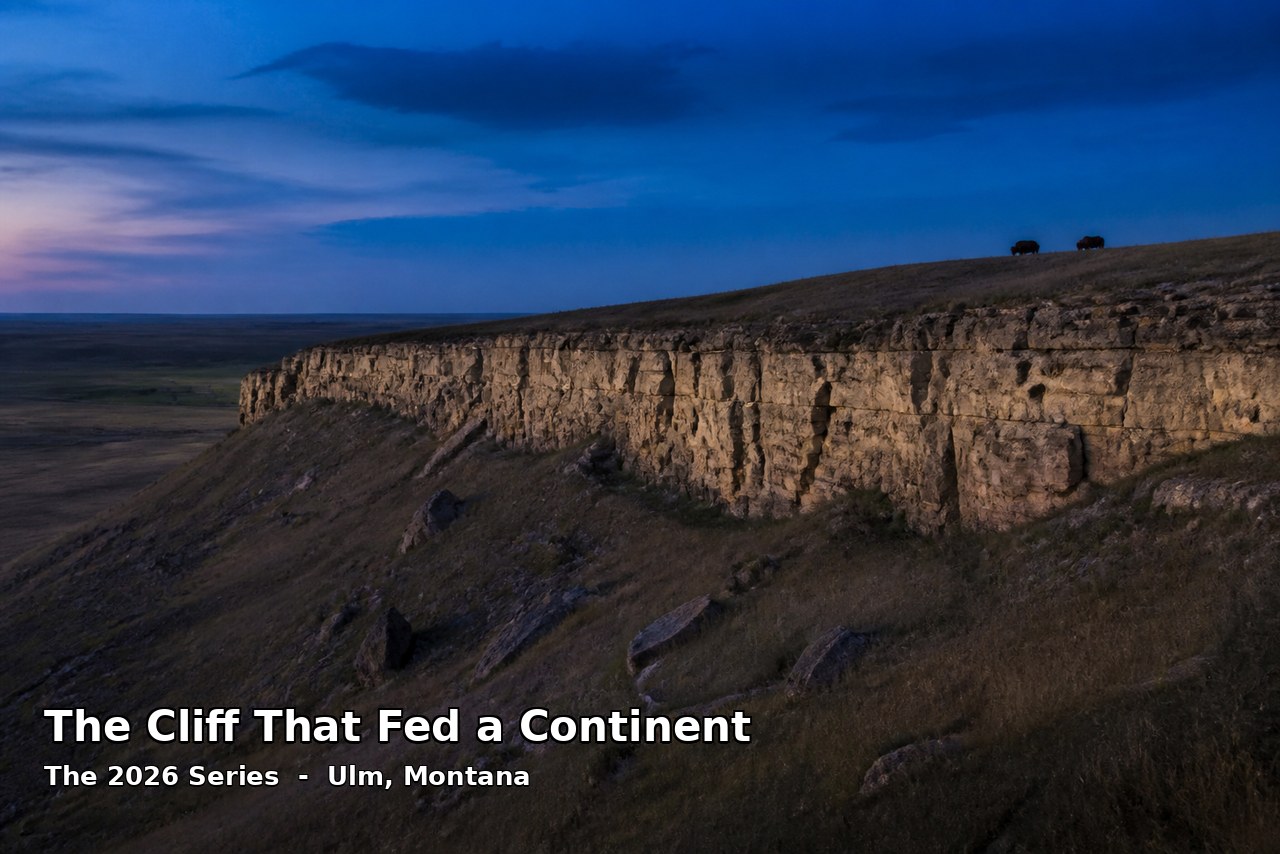
The Cliff That Fed a Continent: Our Day at First Peoples Buffalo Jump State Park
Cold Open: The Cliff
Back in July, we turned off Interstate 15 at the Ulm exit, ten miles southwest of Great Falls, and the northern plains opened up in front of us - big sky, wind, grass going gold at the edges, and a horizon that seemed to go on as a matter of principle. Follow the signs northwest on Ulm-Vaughn Road, and after about three and a half miles you see it: a long, low rampart of sandstone rising out of the prairie. Honestly, it doesn't look like much at first. The cliff is only 30 to 50 feet tall and a mile long, a gentle staircase of a landform you could walk up in ten minutes.
Then you learn what's under it.
Beneath that modest sandstone rim lies a bed of compacted bison remains up to 18 feet deep, running the entire length of the cliff. Archaeologists estimate that at least 6,000 bison died here over the course of a thousand years, and some argue it was the most heavily used buffalo jump anywhere in North America - maybe the world. This is First Peoples Buffalo Jump State Park, 1,481 acres of prairie and stone that fed a continent, and one of the most quietly overwhelming places we've ever stood in Montana.
A Machine Made of Landscape
The Blackfeet word for a place like this is pis'kun - literally, a "deep blood kettle." It is not a subtle name, and the park does not sand it down. This was an industrial-scale harvest, engineered by people who had no horses, no metal, and no wheels, who solved the problem of killing a two-thousand-pound, famously ill-tempered animal with nothing but topography, patience, and teamwork.
The method worked like this. Hunters - somewhere between a dozen and a hundred people, archaeologists think - would find a grazing herd miles away and slowly, carefully begin to encircle it. They would ease the animals toward a low hill leading up to the cliff, funneled along drive lines: corridors marked by hundreds of stone piles, about 260 of which still survive near the hilltop. Runners trained from childhood - some oral traditions describe young men draped in buffalo robes who would race ahead of the herd, luring it forward - kept the animals moving. When the moment came, hunters hidden behind the rock lines, some wearing wolf hides, would leap up shouting, and the herd would break into a blind stampede. Too fast to stop, the front animals went over the cliff; the ones behind pushed them on. Legend says the swiftest runners would leap at the last instant, landing on a hidden ledge below while the herd thundered past and over them.
What followed was the part most people never think about: the work. Hundreds of carcasses, processed in a single organized event, by everyone. Meat dried and pounded with berries and fat into pemmican. Hides for tipis and clothing. Sinew for bowstrings and sewing. Bones for tools. Blood boiled in shallow pits lined with hide and rock - the blood kettles the cliff is named for - to keep it from spoiling. Researchers studying similar jumps have estimated that a single successful hunt could feed four hundred people for more than three months. Nothing was wasted, because nothing could be.
Deep Time
Carbon dating places heavy use of this cliff beginning around 900 CE, with some evidence of use as early as 500 CE - and possibly far earlier. In 2011, park archaeologists found a projectile point that initial estimates put at as much as 5,000 years old, which would push the story back beyond anything the site currently claims.
At least seven tribes carry oral histories that include this place: the Piegan Blackfeet, A'aninin, Assiniboine, Cree, Kalispel, Salish, and Shoshoni, each with their own name for it. The bone bed itself is the deepest kind of archive - it shows hunters refining their craft over centuries, from simple hide-and-meat stripping to the full pemmican-and-blood-kettle economy of the later jumps.
And then, around 1700 CE, the cliff went silent. The horse arrived on the plains, and hunting on horseback made the great communal drives unnecessary. The pishkun was used for over a millennium and abandoned in a generation or two, leaving the prairie to keep its secret until homesteaders and archaeologists came asking questions.
Walking the Hunt
We started, as you should, at the visitor center - a 6,000-square-foot building at the base of the hill, the first buffalo jump interpretive center in the nation when it opened in 1999. The exhibits walk you through buffalo culture and the mechanics of the hunt, and the set pieces are memorable: a life-size tipi made of actual buffalo hides, a 160-foot mural of the surrounding landscape, and a genuine please-touch table of skulls, hides, and furs that Cindy worked through twice.
Then we hiked the two-mile interpretive trail that climbs from the visitor center to the cliff summit and back. Even in July's heat, we went late morning and it was manageable - the wind does some of the cooling for you - but bring water, sun protection, and windproof layers. The trail is signed the whole way, and there's a stone tipi ring along the route. What makes it special is that you literally walk the route the bison ran, and from the top you get the animal's-eye view: the plains rolling out forever, thunderheads stacking up over the mountains the day we were there.
On the way back down we spent a long, happy half hour at the black-tailed prairie dog town - a whole colony chirping, popping in and out of their burrows, with burrowing owls and hawks working the edges. Bring the long lens if you have one; the wildlife here is used to people but keeps a respectful distance.
If hiking isn't in the cards, a gravel road (Taft Hill Road) also reaches the summit area - though RVers should leave the rig at the visitor center. It's a rough dirt drive, and reviewers note there's no signage at the viewing point itself.
Last Light
We stayed until late afternoon, when the tour groups were gone and the wind owned the place again. Meadowlarks. The hum of prairie dogs. The long grass moving like water. It is hard to imagine thunder here - the drumming of a thousand hooves, the shouting, the leap, the quiet afterward when the hillside wept bones and a whole community turned carcass into winter. The cliff did not conquer the buffalo. The people didn't either. They simply learned the shape of the land so well that the land itself became the hunt.
That's worth ten minutes of anyone's drive along I-15. It's worth a detour from anywhere.
If You Go
First Peoples Buffalo Jump State Park is at 342 Ulm-Vaughn Road, Ulm, MT 59485 - about 10 miles from Great Falls via I-15 to the Ulm exit, then 3.5 miles northwest. Summer hours are 8 a.m. to 6 p.m. daily; winter hours are 10 a.m. to 4 p.m. Montana residents visit free; out-of-staters pay a small per-vehicle day-use fee. This is strictly a day-use park - no camping - so plan on at least two hours, longer if the wind talks you into staying.
The park runs a rich warm-season calendar: Saturday afternoon "Jump Talks," full-moon and sunset storytelling hikes, guided off-trail walks to pictographs and petroglyphs, an annual art show, the Montana Atlatl Mammoth Hunt competition, and the two-day Buffalo Kite Festival each mid-June, when the sky above the cliff fills with kite-shaped buffalo. Check the Montana FWP events page before you go.
For RV travelers, the park makes an easy day trip from Great Falls, where you'll find full-hookup parks like Great Falls RV Park, the Great Falls KOA, and Prewett Creek RV Park. Make a day of it: pair the jump with Giant Springs State Park and the Roe River, the superb Lewis and Clark Interpretive Center, and the C.M. Russell Museum downtown. Refuel the stomach as well as the truck - Great Falls has solid Mexican food at spots like Xochitl Cocina \& Tequila, and Mighty Mo Brewing Co. pours local beer near the riverfront.