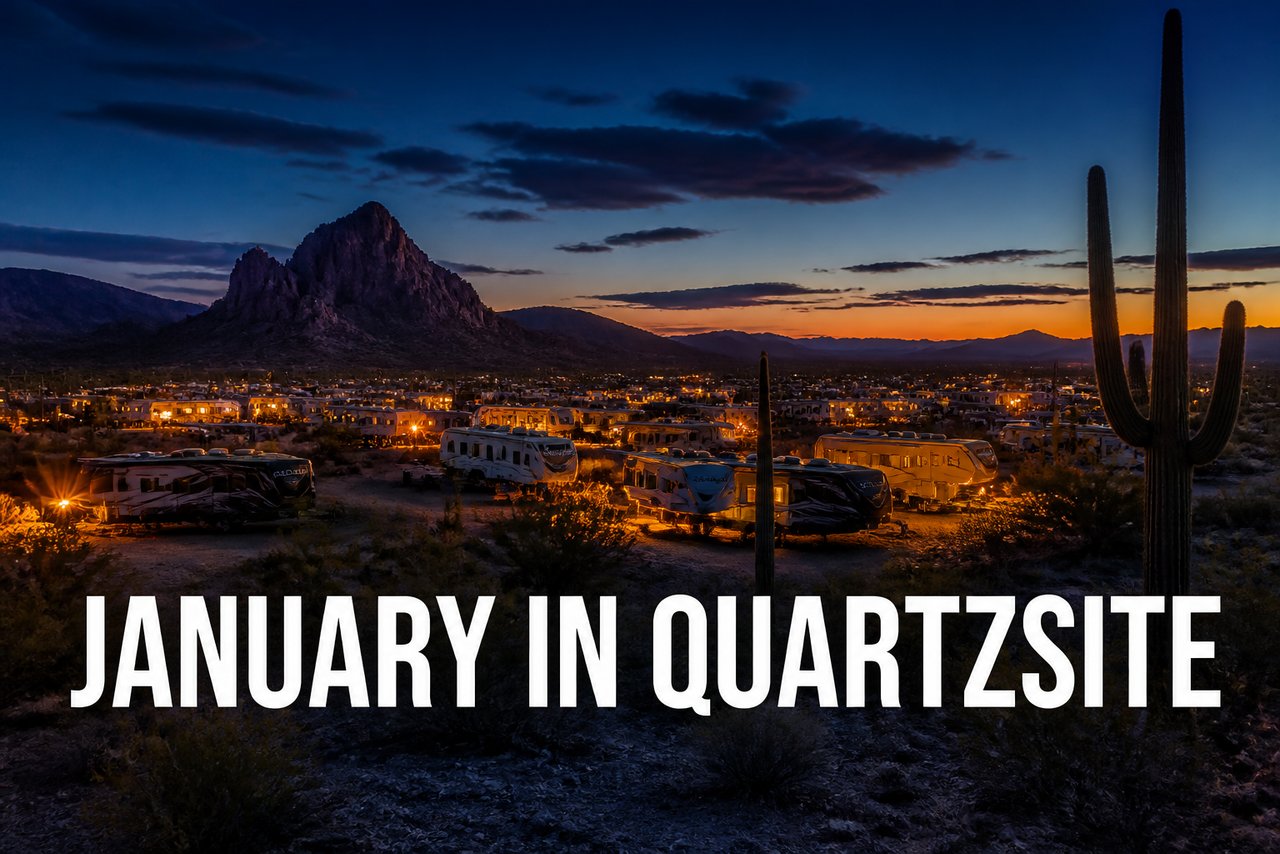
Quartzsite, Our January Home: Snowbirds, Rocks, and a Camel Driver's Grave
Every January, a town of about four thousand people in the Sonoran Desert quietly becomes one of the busiest places in Arizona. Rocks and gems pile up under white tents. Vehicles of every shape - from rusty bug-out buggies to quarter-million-dollar motorhomes - stretch in every direction across the desert floor. And somewhere near the center of it all, a camel driver from the 1850s rests under a pyramid.
Welcome to Quartzsite, our winter home.
Fourteen Miles of Neighbors
We roll into Quartzsite each January after the holidays, when the desert has cooled off and the crowds have arrived. The town sits at the junction of Interstates 10 and 95, about twenty miles east of the California line, and in winter it absolutely hums. Boondocking - camping out here with no hookups, no pads, no neighbors closer than you like - is the whole point. The Bureau of Land Management runs the Long Term Visitor Areas around town, and for a modest seasonal permit you can park on public land for the entire season. People have marked out their favorite patches of desert for decades.
On paper, Quartzsite is a town of a few thousand souls. In January, the winter influx is counted in the hundreds of thousands - some estimates say more than a million visitors pass through over the season. On our walks we have watched the desert fill up like a slow-motion parade: everybody parked nose-out, solar panels tilted toward the morning sun, generators humming quietly at breakfast and going silent by nine.
There is a rhythm to life out here. Mornings start with coffee outside while the Chocolate and Dome Rock mountains catch the first light. Midday is for errands - a hardware store the size of an airplane hangar, three casinos, a grocery run into town. Evenings are for campfires and the parade of solar lights coming on across the desert, one little amber dot at a time, until the whole valley looks like a city that decided to lie down.
From Tyson's Wells to Quartzsite
Quartzsite's story starts long before the RVs. In 1866, a stage stop called Tyson's Wells opened here on the route between the Colorado River steamboat landings and the interior mines - a muddy water stop in the middle of nowhere with big dreams attached. It fizzled when the mines played out, but quartz brought prospectors back, and the little settlement eventually took the name of an early settler, a German prospector known as Quartzsite Tyson.
The desert around town holds even older stories. The Kofa National Wildlife Refuge to the south protects bighorn sheep country and one of the rarest palms in the Southwest, hidden in a canyon so narrow the sun barely touches the fronds. Old mining roads still spiderweb out from town in every direction, and half the fun of a Quartzsite January is picking one and seeing where it goes.
The Camel Who Wouldn't Quit
The strangest chapter in Quartzsite's history involves camels - real ones. In the 1850s, the U.S. Army imported camels from the Middle East to haul supplies across the desert Southwest, an experiment championed by then-Secretary of War Jefferson Davis. The camels did fine. The Army, distracted by the Civil War, lost interest, and the animals were turned loose or sold off.
One of their drivers stayed. Hadji Ali - the soldiers called him Hi Jolly - settled in this corner of Arizona, worked as a scout and prospector, and lived out his life among the quartz hills. When he died in 1902, he was buried in Quartzsite's cemetery, and decades later the town raised a pyramid-shaped stone monument over his grave. It is still there, and it is still the first stop for nearly every visitor in town. Standing there, you get a real sense of how long the trail of odd, tough, independent characters through this desert really is - and how nicely we full-time travelers fit into it.
The Boom Town That Pops Up Every Winter
What Quartzsite is really famous for is the swap meets. From late fall through winter, the town sprouts vendor rows - everything from bladed tools and turquoise to auto parts, leatherwork, and hot food. The big gem and mineral shows peak in January and February, led by the QIA Pow Wow and a sprawl of tent shows where dealers sell specimens and slabs and jewelry from all over the world.
You can spend a whole day walking the aisles and barely dent them. We know, because we have tried. Somewhere between the rock booths and the food trucks you will run into neighbors from a campground you stayed at three states back - Quartzsite is a small town the size of a small county, and everybody in it owns an RV.
For us the January ritual is simple. Stock the pantry, fill the water, point the solar at the sky, and settle into the desert. There is no schedule. When the mood hits, we drive into town for the swap meets or take a day run up to the Kofas. When it does not, there are sunsets you would not believe, right there over the cookies - the local name for the cookie-cutter hills west of town - and a sky full of stars by seven.
Why We Keep Coming Back
Some people do not get Quartzsite, and that is fine - it is not for everyone. But for full-timers, January here feels like a family reunion disguised as a rock show. The desert is wide enough for everyone's opinions, the weather is the reward for the drive out, and the history - camel trains, stage stops, booms and busts - is thick enough to kick up with your boot.
If you are passing through on I-10, do yourself a favor: take the exit. Climb the pyramid at Hi Jolly's grave, grab a date shake, and watch the desert light turn gold, then pink, then that impossible deep blue. Then you will understand why thousands of us keep pointing our rigs here every winter.